Tip of the Week: Self-insured Employers Must Draw a Line in the Sand between them and Non-fiduciary Pharmacy Benefit Managers

Midwest Business Group on Health or MBGH has drawn a line in the sand. In order to help employers
improve the efficiency and value of pharmacy benefit programs to drive affordability and transparency, the Midwest Business Group on Health recently released a new report.
Click to Learn More
The report, Drawing a Line in the Sand: Employers Must Rethink Pharmacy Benefit Strategies, is part of MBGH’s National Employer Initiative on Specialty Drugs. In 2010, MBGH embarked on a multi-year, employer-led project to address their concerns about the rising costs of biologic and specialty drugs. Project activities offer all employers access to knowledge, benchmarking, best practices and tools and resources at no cost through an online employer toolkit.

Tyrone’s Commentary:

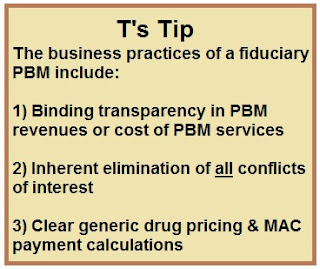
Seems that MBGH and TransparentRx have a lot in common at least in choice of words. Actions are what matter most.

The report offers a call to action on the key issues and important steps that public and private employers need to take to:

  • Understand how “today’s middleman model” contributes to higher costs in the supply chain
  • Identify ways to work with vendors to reduce unnecessary costs and drive efficiency

“As fiduciaries, employers have a duty to be ‘good stewards’ of how premiums are used to fund care for employees and beneficiaries,” said Cheryl Larson, MBGH vice president and primary report author, when announcing the report. MBGH non-profit employer coalitions of 130 mid, large and jumbo self-funded public and private employers, representing over 4 million lives and annually spending over $4 billion on health care.

“Most pharmacy benefit manager (PBM) arrangements are complex, making it difficult for employers to identify the true cost of drugs and all the sources of PBM revenue,” Larson added. “Employers need to know the facts and act to make sure their benefit dollars are spent in an efficient manner and rebates and other revenues are appropriately received.
<<Download Full Report>>

Tuesday Tip of the Week: Lead with Transparency or a Non-Fiduciary PBM’s Pricing Analyst will Exploit Your Lack of Sophistication

In the PBM industry, ballooning occurs when one revenue stream is cut off only for the PBM to shift that lost revenue to a different source. One way non-fiduciary PBMs maximize ballooning is with the help of Pricing Analysts. Yes, it is true that large PBMs have pricing analysts on staff.
One of the core responsibilites of a PBM Pricing Analyst is to monitor revenue performing below thresholds and implement necessary tasks to bring performance to or above targets. Doesn’t it make sense then that if you are seeking better pricing from a PBM to start with the contract language and not higher rebates or discount guarantees? Here are some additional duties of a PBM pricing analyst.
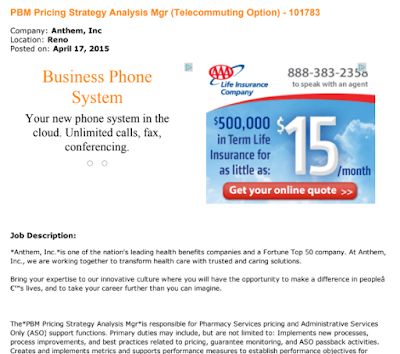
  • Implements new processes, process improvements, and best practices related to pricing, guarantee monitoring, and ASO passback activities.
  • Creates and implements metrics and supports performance measures to establish performance objectives for revenue maximization and pharmacy pricing.
  • Creates tools and processes to monitor margin revenue, pricing accuracy, and client retention.
  • Implements pricing in the system related to margin.
  • Supports the Pharmacy Services team in implementing future revenue, member expansion and growth capacity.
  • Assists with developing pharmacy pricing training to underwriters and updates to underwriting guidelines.
During negotiations with a non-fiduciary PBM, you may win more pricing concessions but all you’ve really accomplished (without any material change in the contract language) is to make the pricing analysts job a little tougher. Let’s put it another way. Instead of 4th and inches, it is 4th and one to payday.

Click Here to View the Original Job Ad and Description
PBM Pricing Analysts are limited primarily by one thing in their quest to extract hidden cash flow from employers – Contract Language. The position of PBM Pricing Analyst is unnecessary when the PBM operates as a fiduciary or radically transparent service provider. Better yet, this position is ineffectual when employers, not just their independent consultants, across the country get more PBM education.
PBM Pricing Analyst is a full-time position dedicated to drive PBM top-line growth. Much of your non-fiduciary PBM’s margin occurs after you’ve signed on the proverbial dotted line. A non-fiduciary PBM will give the appearance of a better deal but rarely does it relinquish profits without also providing more transparency. Start with transparency then focus on spreadsheet analysis of pricing.
Pharmacy costs and PBM transparency are not mutually exclusive they are forever intertwined. When the non-fiduciary PBM’s hand is in the cookie jar, employers pay less when you are looking at the cookie jar and know full well how many cookies are in it.