Three surefire ways to know if your PBM is overcharging you

Pick anyone from HR, finance or procurement and they will tell you succinctly the pharmacy cost trend is not sustainable. Most have tried every trick in the book including increasing employee cost share, restricting access or reducing benefit levels. But, ask these same professionals how much money their PBM is making and you’ll likely get crickets. It is not uncommon for the non-fiduciary PBM’s take home to amount to more than the cost of the prescription drugs.

I’ll let the note Michael Critelli, former CEO at Pitney Bowes, sent to me address that point. “I am pleased that you wrote the particular essay I downloaded. Many corporate benefits departments do not understand that they are overmatched in negotiating with pharmacy benefit managers, as are the “independent consultants” who routinely advise them. The first step in being wise and insightful is admitting what we do not know, and you have humbled anyone who touches this field.” 


For those interested in improving their company’s pharmacy benefit management results and unafraid of unconventional concepts, here are three surefire ways to know if your PBM is overcharging you.

1) Contract definition for brand and generic drugs. Brand Drug means a prescription product identified as a “brand” by Acme PBM or its designee using indicators from reporting services such as First Databank or other third party reporting sources. If your definition for brand or generic drugs looks remotely close to the example above, then you are being overcharged.

2) Contract definition for rebates. The definition for rebates in your contract should not include any exclusions or limitations. Strike any language that reads similar to Rebates do not include administrative fees paid by Pharmaceutical ManufacturersRebates do not include purchase discounts paid by Pharmaceutical Manufacturers, or directly attributable to the utilization.

3) Low or no administrative fee. An artificially too low administrative fee is a dead giveaway for overpayments. This is especially true when the plan sponsor has no audit rights on pharmacy reimbursements, no ability to determine net costs through NDC claim level detail for rebates, or finally little input on benefit design beyond member cost share, for instance.

Managing the pharmacy benefit efficiently is no easy task. It requires quite a bit of time, effort and skill to do it right. Anyone with business training can look at a P&L statement and determine whether or not a company made a profit. However, understanding the story behind those numbers requires a certain set of skills only a certified public accountant can provide, for example. The same can be said for pharmacy benefits as it too requires a particular set of skills and values to achieve lowest net cost.

Tip of the Week: Claims Repricings as the Primary Tool in Evaluating PBM Proposals is Like Buying a Used Car Without Ever Looking Under the Hood [Rerun]

I always stress the importance of PBM contract language. That the language (transparency or lack thereof) in the contract will have the biggest impact on PBM cost performance is clear. More specifically, whether or not a plan sponsor has entered into a fair deal or bad deal with a pharmacy benefits manager.

If you believe a claims repricing or spreadsheeting is the best way to evaluate PBM proposals, then I’ve probably lost you already. They have a place in the evaluation process but should not be the primary tool. Using spreadsheets as the primary tool in evaluating PBM proposals is like buying a car without ever looking under the hood! It is the equivalent of signing the sales agreement only to find out later the price didn’t include an engine.
Spreadsheets are just easy and what most evaluators of PBM proposals are most comfortable with. They are numbers so it is simple to rank the results. Far too often the “lowest” cost wins and the better or more transparent deal is left in the cold. The truth is non-fiduciary PBMs have learned how to leverage the purchasing power of unsophisticated plan sponsors to their financial advantage. In other words, they give you the optics or what you want to see in exchange for what essentially equates to a blank check.
Click to Learn More
PBM contract language gives the purchaser a peek into the future as to what is really going to happen – after the plan goes live! A claims repricing, for example, provides a look into the past. Alone, a claims repricing is not a reliable indicator of what costs might be in the future. The contract dictates how a PBM should behave. A contract with radically transparent language prevents the PBM from taking a rent-seeking strategy. Proposals with opaque contract language should de discounted. 
Conversely, proposals with radically transparent contract language should be given a premium. Make sure your broker or consultant is an expert at scoring PBM contracts. Ask for samples of their contract scorecards and the methodology. That is step one. Step two is to make sure your consultant maintains a PBM contract management system. 
Many of those conversations I mentioned at the beginning, uncovered the broker or PBM consultant didn’t know where their clients’ contracts were located. Even more scary is they didn’t know if the PBM would give them a copy. In our personal lives contracts reign supreme but when it comes to pharmacy benefits some stakeholders can’t even find the darn thing. 
With so much at stake it belies professionalism. It’s no wonder 90% of plan sponsors are overpaying to provide a pharmacy benefit to their employees. The one thing which matters most is being placed at the back of the line. Review your PBM contract periodically and make notes for concessions you want during renewal.

Tuesday Tip of the Week: It is a Myth That Any Pharmacy Benefit Manager Offers Better Price Savings Because of Their Size

It is a myth that the Big 6 (ESI, CVS, Optum, Humana, MedImpact and Prime) offers better price savings just because of their size. The myth is often perpetuated by the old guard who for a long time have personally benefited from overpayments received from opaque PBM business practices. We can’t expect the old guard to bite the hand that feeds them, can we?


Sure, the Big 6 have more purchasing power, but their clients often don’t realize the full benefit. For example, if our rebate aggregator pays us, TransparentRx, a $3000 rebate for drug “A” every penny goes back to the client with an audit trail. The audit trail includes claim level detail (e.g. claim number, NDC, date and rebate amount) for every drug which earned a rebate payment. 


The Big 6 might earn $4000 on that same drug, but retains $1200 in-house, for instance. The plan sponsor pockets an additional $200 working with a radically transparent, albeit smaller, PBM. Without an audit trail a PBM could earn a rebate on a drug and not share any of those dollars with the plan sponsor who actually earned it. A similar scenario plays out in mail, specialty and retail pharmacy networks.

Price quotes (RFPs etc…) are simply an estimate of what the plan sponsor would have spent had the historical utilization matched that of the proposing PBM (a lot in this sentence). Furthermore, the future actual cost is unknown. As a result, the plan sponsor’s PBM contract is the most important tool to address the actual level of spend – not cost projections. Non-fiduciary PBMs know full well what you like to see in proposals. When contract language is opaque, the non-fiduciary PBM starts to eat away at the proposed savings, i.e. discount and rebate guarantees, as soon as you go live.

If you’ve never considered the PBM management fee in how you procure pharmacy benefit management services, watch this free webinar. The PBM management fee isn’t what you think it is. It is largely the undisclosed fee a PBM charges for providing their services to plan sponsors. For non-fiduciary PBMs, the bulk of this fee is buried in the final plan pharmacy cost. It goes without saying, the contract is king.

Tuesday Tip of the Week: If I were a plan sponsor here are the seven things I would be asking of PBMs during an RFP

RFP season is in full swing and a little later than usual for obvious reasons. It’s mind-boggling what PBMs are asked to do in some of these RFPs. The responses we provide are sophisticated. Isn’t it reasonable to then expect that the evaluation of those responses be equally sophisticated? If I were a plan sponsor here are the seven things I would be asking of PBMs during an RFP.

1. PBM Contract. Do you know why spreadsheeting PBM pricing offers is held in such high regard? Business math is easy 2 + 2 = 4. PBM contract evaluation isn’t so easy so decision-makers hand it off to the corporate attorney who can’t tell you the difference between ASP and WAC. I’m not suggesting the corporate attorney isn’t smart. Of course they are smart but that doesn’t mean diddly squat unless you have a trained-eye for pharmacy benefits. The problem for plan sponsors who wait until the last minute to address contract nomenclature is that it is the most important factor in determining whether your plan overpays or pays a fair price for PBM services. In PBM contracts 2 + 2 ≠ 4. Discount and rebate guarantees mean less when contract nomenclature is ambiguous.

2. Benefit Design. Never once during hundreds of RFPs has any consultant or broker ever asked us for a completed benefit design as part of our response. I’ve not taken a poll so I don’t know the reason. Maybe it is because some believe benefit design doesn’t have a big role in determining cost. If that is the case, nothing could be further from the truth. Don’t put 50 questions in a RFP around benefit design where important details get lost in translation…geesh. I would be asking for a benefit design to be submitted as if we were going live with it. In pharmacy cost drivers, price is 1A and benefit design is 1B. Aside from copayments and deductibles (cost sharing) most plan sponsors know little else about their benefit design and have left it up to the PBM to decide. When the PBM is non-fiduciary that could lead to significant overpayments.

Click to Learn More


3. References. 2-3 companies who can verify the PBM’s claims (i.e. retail network, mail and specialty access and transparency) about performance. This could also include inquiries about account management and member support performance.

4. Questionnaire. 20 – 25 verifiable questions pertinent to my company’s needs. Here is where you inquire about security, reporting, disease management, MTM or alternate funding programs.

5. PBM Reverse Auction. Two PBM reverse auctions in the same competitive bidding process in fact. The first round is conducted after the claims repricing is submitted. The second round is completed after all contract concessions have been made and the resulting contracts memorialized. Usually you are down to 3-5 candidates at this point. Keep in mind that in a well run and organized reverse auction prices only go down.

6. Finalist Presentation or Interview. Don’t allow PBMs to turn it into a marketing contest. Use the time to win more contract concessions and clear up any lingering concerns.

7. Claims Repricing. Not for the purpose of determing who has the better price but to make sure the PBM is in the ballpark of the market. Claims repricings tell you what happened in the past. Claims repricings can’t tell the story of what is going to happen in the future. The PBM contract and benefit design are better suited to help predict future performance. Furthermore, if the incumbent PBM has leveraged bad product mix or poor utilization to generate its management fee you are asking PBMs in the bidding process to reprice those same bad claims.

Now score each of the six areas (excluding repricing). Here are some weights I recommend applying to each score:

Contract – 40%

Benefit Design – 25%

References – 10%

Questionnaire – 5%

Reverse Auction – 15%

Finalist Presentation – 5%

As you can see the repricing has earned no weight. The claims repricing serves to show only if the pricing is competitive nothing more. The reverse auction will establish pricing guarantees and the contract will help determine whose pricing is the most transparent. It takes time to get really good at any of these areas. Don’t give up on them the first or even second time around.

The best proponent of radical transparency and lowest net Rx cost is informed and sophisticated purchasers of PBM services. I’m not talking about 1400 SAT or 4.0 GPA sophistication. I’m referring to a high level of sophistication in the PBM arena. If it isn’t your bag don’t carry it. Find someone else who specializes to do the heavy lifting for you.

Tuesday Tip of the Week: Deadlines get deals done

It was about a month ago I was sitting behind the wheel of my automobile listening to sports talk radio. I know…there are much better options, such as NPR, but I needed an escape. My timing couldn’t have been better, however. The segment I caught was about the Dallas Cowboys and their ongoing negotiations with starting quarterback Dak Prescott.

Dak after being told he gets a one year deal
If you don’t know the story and why would you if you’re not a football or sports fan but here is the background. In the NFL, high-performing rookies are essentially locked into less than market value contracts for up to 5 years. A NFL team could extend the contract before expiration if it so chooses. In many cases, they do just that especially when the rookie has outperformed their contract and has stayed out of trouble.
Enter Dak and the Cowboys who opted to franchise tag Dak. A franchise tag is essentially a one-year deal with no long-term guarantees or committment from an NFL team. Does this sound familiar? NFL quarterbacks who are considered franchise type quarterbacks rarely get the franchise tag. Teams try and lock them up for the long-term. But when the team doesn’t trust a player enough to lock them up long-term it uses the franchise tag.
Many self-funded employers are opting to franchise tag their PBM instead of going into 2-3 year contracts. Why, because you don’t trust them! Who wants to go through a bidding process every six months unless it’s absolutely necessary? No one, thus the reason I wrote this blog post. One year deals give PBMs a lot of leverage. Have you ever wondered why it’s like pulling teeth to get access to your own claims data but when the contract is up for renewal it seems to find its way to your inbox?
Jerry Jones, the owner of the Dallas Cowboys, said something I always knew but for some reason this time it really resonated with me. In reference to his negotiations with Dak Prescott and his agent, Jones said, “deadlines get deals done.”  In our world, this is the same leverage PBMs use to get employers into deals which lead to contract opacity and significant overpayments. Pharmacy Benefit Managers are well aware employers must get ID cards into the mailboxes of their employees.
In other words, non-fiduciary PBMs prefer short windows to get service agreements executed. Short windows lead to wasteful and duplicative spending especially on management fees. PBMs will generally provide transparency and disclosure to a level demanded by the competitive market and rely on the demands of clients in negotiating their contracts. Here are some useful tips:
1) Make the contract the centerpiece of any PBM selection process.
2) If the contract is 1A, the benefit design is 1B. Who has control you or the PBM?
The best proponent of radical transparency and lowest net Rx cost is informed and sophisticated purchasers of PBM services. I’m not talking about 1400 SAT or 4.0 GPA sophistication. I’m referring to a high level of sophistication in the PBM arena. If it isn’t your lane don’t play in it find someone who does.

Tuesday Tip of the Week: 3 Common Places PBM Overcharges Occur

The fundamental issue with PBM valuing, to kind of distil it out, is it is significantly more muddled than most purchasers might suspect. In the event that an individual not knowledgeable in evaluating PBM proposals takes a gander at PBM services agreement, it may have all the earmarks of being straight forward and basic, since they don’t comprehend what it is that they’re perusing.
 
Self-funded employers don’t need to sit tight for PBMs to provide full disclosure, in any case. They can employ continuous monitoring and watch for overpayments in house. Here are three basic spots overpayments happen that each payer should immediately act upon.
 
1)  Tighten Up Contract Definitions
 
To genuinely forestall PBM overcharges, employers need to know and fully comprehend the fine print inserted in their agreement language. Numerous employers may think the meanings of “brand” and “generic” drugs are really standard. A brand drug is normally viewed as a patent-protected FDA-approved medication, while a generic or non-exclusive drug is a pharmaceutical that utilizes the same active ingredients as a brand drug that is not, at this point patent-protected.
 
That apparently standard definition, in any case, probably won’t be the one in your agreement. Some PBM contracts characterize a brand drug as a medication that is either patent-protected or one that has a single source generic, which could increase costs for employers. On the off chance that the PBM has changed the meaning of brand to incorporate single source generics, that viably implies more medications are estimated at the brand rate than should be. Therefore, the PBM’s clients likely could be following through on a brand cost when they ought to be addressing a much lower non-exclusive medication cost.
 
2) Make Sure You Have a Recent MAC List
 
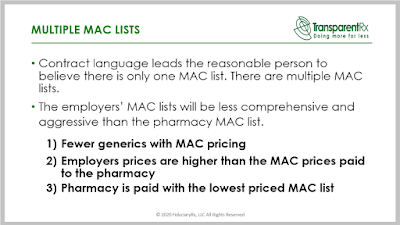
Another area self-funded employers are being overcharged is in the spread between retail pharmacy MAC Lists and the PBM’s MAC List. MAC lists determine the maximum allowable cost that a PBM plan will pay for generic drugs and multi-source brands. Overcharges occur when there is a spread between the MAC list used by a retail pharmacy and the one used by a PBM. For example, a pharmacy’s MAC list may price a drug as ten cents per tablet, but the PBM may charge seventeen cents per tablet.
 
 
Click to Learn More
 
 
Another potential problem is MAC pricing. The payer thinks that they’re getting a good deal because they have a MAC price, which is separate from the AWP minus or U&C pricing. MAC lists are supposed to protect employers from gaming by retail pharmacies. In reality, non-fiduciary PBM margins on MAC guarantees can be bigger than non-MAC’d drugs. What can self-funded employers do to prevent these types of overcharges? You should implement a continuous monitoring process. Continuous Monitoring or CM would have identified this problem before it got out of hand. Audits occur 12 -18 months after the fact which is too late to claw back the majority of overpayments. Continuous Monitoring on the other hand, catches and resolves overpayments or other issues much much faster. 
 
3) Get All Manufacturer Revenue Earned
 
The intent of manufacturer revenue or rebates, on the buy-side, is to reduce the net cost of prescription drugs. When the PBM keeps a share, whether disclosed or undisclosed, self-funded employers pay more for those drugs. Non-fiduciary PBMs engage in renaming those dollars [rebates] in an attempt to deceive employers. The amount of rebates paid to an employer is only as strong as the definition for rebates in the contract. The non-fiduciary PBM will try to force your hand into accepting an opaque definition for rebates. Don’t do it.
 
In conclusion, PBMs will generally provide transparency and disclosure to a level demanded by the competitive market and rely on the demands of clients in negotiating their contracts. The best proponent of radical transparency or lowest net Rx cost is informed and sophisticated purchasers of PBM services. In other words, the more you know the less you pay. Unfortunately, most plan sponsors and their independent consultants don’t know what they don’t know.

Tuesday Tip of the Week: Spreadsheets as the Primary Tool in Evaluating PBM Proposals is Like Buying a Used Car Without Ever Looking Under the Hood

Over the last several years, I’ve had conversations with brokers and PBM consultants around how to lower pharmacy costs. In these conversations, I always stress the importance of PBM contract language. That the language (transparency or lack thereof) in the contract will have the biggest impact on PBM performance is clear. More specifically, whether or not a plan sponsor has entered into a fair deal or bad deal with a pharmacy benefits manager.

If you still believe spreadsheeting is the best way to evaluate PBM proposals, then I’ve probably lost you already. Using spreadsheets as the primary tool in evaluating PBM proposals is like buying a car without ever looking under the hood! It is the equivalent of signing the sales agreement only to find out later the price didn’t include an engine.
Spreadsheets are just easy and what most evaluators of PBM proposals are most comfortable with. They are numbers so it is simple to rank the results. Far too often the “lowest” cost wins and the better or more transparent deal is left in the cold. The truth is non-fiduciary PBMs have learned how to leverage the purchasing power of unsophisticated plan sponsors to their financial advantage. In other words, they give you the optics or what you want to see in exchange for what essentially equates to a blank check.
Click to Learn More
PBM contract language gives the purchaser a peek into the future as to what is really going to happen. Proposals with opaque contract language should de discounted. Conversely, proposals with radically transparent contract language should be given a premium. Make sure your broker or consultant is an expert at scoring PBM contracts. Ask for samples of their contract scorecards and the methodology. That is step one. Step two is to make sure your consultant maintains a PBM contract management system.
Many of those conversations I mentioned at the beginning, uncovered the broker or PBM consultant didn’t know where their clients’ contracts were located. Even more scary is they didn’t know if the PBM would give them a copy. In our personal lives contracts reign supreme but when it comes to pharmacy benefits some stakeholders can’t even find the darn thing.
With so much at stake it belies professionalism. It’s no wonder 90% of plan sponsors are overpaying to provide a pharmacy benefit to their employees. The one thing which matters most is being placed at the back of the line. This is as bad as it gets.